Business Credit Score Range [Multiple Bureaus + Calculator]
Author: Dylan Buckley
September 08, 2026
12 min read
TABLE OF CONTENTS
- 1. Business Credit Score Ranges By Bureau
- 2. Dun & Bradstreet PAYDEX Score Range (1–100)
- 3. Experian Business Credit Score Range (1–100)
- 4. Equifax Business Credit Score Range (0–300)
- 5. FICO SBSS Score Range (0–300)
- 6. Creditsafe Business Credit Score Range (1-100)
- 7. What Is A Good Business Credit Score?
- 8. What Factors Affect Your Business Credit Score Range?
Start your credit building journey for your business

Your business credit score plays a direct role in your ability to secure funding. The higher your score, the more likely lenders are to work with you. Our business credit score range calculator reveals your current standing.
Below, we provide you with further insight into what scores mean, factors that influence them, and beyond.
Business Credit Score Ranges By Bureau
Dun & Bradstreet PAYDEX Score Range (1–100)
The Dun & Bradstreet PAYDEX score is an important business credit score starting out. It’s a bit different from scores from other credit bureaus. Your PAYDEX score tells lenders whether you pay suppliers and vendors on time.
The Dun & Bradstreet PAYDEX score ranges from 1 to 100. The higher your score is, the less of a risk you appear to lenders.
A score of 80 indicates that you pay your bills on time. It shows that your trade credit history is in good condition.
Higher ends of the range indicate that you pay your bills earlier than the due date. For example, if you pay your bills 30 days in advance, you can surpass 80 and get a higher PAYDEX score.
Anything below 80 indicates that you pay slightly past the due date or are frequently late. A score of 79 reveals that you may have had some problems, but are otherwise on time. The lower your number goes, the more your payment history reflects delinquency.
Building your PAYDEX score will help you access better funding opportunities. Get started with net 30 vendors, place orders, and then pay promptly to boost your score. More vendors will flesh out your business credit report.
First, however, you will need to sign up for a DUNS number. You can use it to sign up for these net 30 accounts and build business credit history.
Experian Business Credit Score Range (1–100)
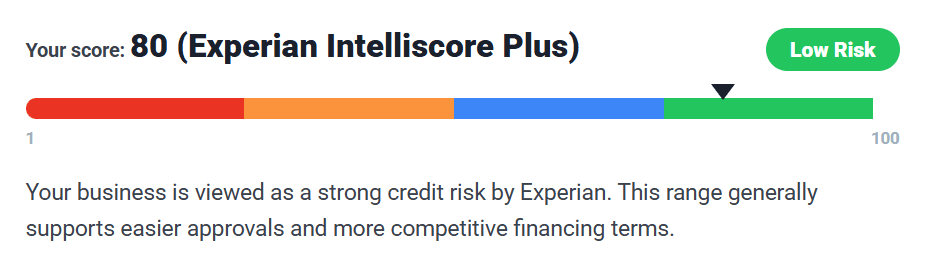
Most business credit bureaus don’t rely on just one score. That being said, there are often a few standout scores that lenders will look at. In the case of the credit reporting agency, Experian, you should focus on Experian Intelliscore Plus.
This Experian business credit score is a score that evaluates your risk of serious delinquency.
Experian has three versions of Intelliscore Plus. Intelliscore Plus V1 and V2 have a score range of 1 to 100. Anything from 76 to 100 is considered low risk. A score of 51 to 75 is considered low to medium risk. Anything below that is considered medium to high risk.
With that in mind, Experian recently developed Intelliscore Plus V3. This score now resembles traditional consumer credit scores. This score ranges from 300 to 850. Much like FICO scores, anything from 781 to 850 is great and considered low risk.
In this model, scores from 721 to 780 are considered low to medium risk. Anything below that is considered medium to high risk.
The new Intelliscore Plus V3 from this business credit bureau can help you:
- Gain a comprehensive overview of your business’s activity and financial health. You can see payment trends, public records, and more. - Your score is calculated using your credit utilization ratio, credit history or payment history, and trade payment data.
- Receive a blended score, which is especially beneficial for small business owners.
- Access a score that doesn’t include self-reported data.
Equifax Business Credit Score Range (0–300)
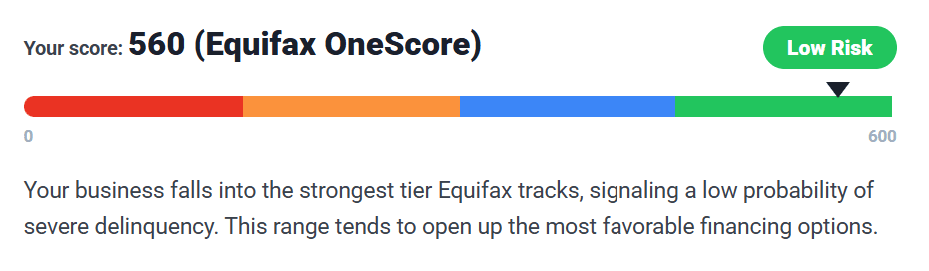
Equifax leverages a multi-score model to demonstrate financial health and predict business failure. You might hear that the Equifax business credit score ranges from 0 to 300. However, the true Business Credit Risk score ranges from 101 to 992.
Scores ranging from 892 to 992 demonstrate the lowest risk. Scores of 788 to 891 indicate low risk. Scores below that range from medium risk to very high risk.
Equifax business credit scores are quite important. While you’ll want strong business credit across the board, your Equifax scores matter because they’ll be used for business insurance underwriting, commercial credit applications, and vendor and supplier credit decisions.
Equifax pulls its data from suppliers, public records, and financial institutions. As with many other scores, it looks at both payment history and credit utilization data.
It’s worth looking into Equifax’s other business credit scores as well. Equifax has a Payment Index score that is similar to the PAYDEX score. It has a range of 0 to 100, with higher scores indicating lower risk.
There’s also the Business Failure Score. This Equifax business credit score ranges from 1,000 to 1,880. It predicts the likelihood of severe financial distress.
FICO SBSS Score Range (0–300)
If you’re planning on applying for an SBA loan, your FICO SBSS score matters tremendously.
Lenders will often look at your FICO SBSS score first when considering you for SBA-backed financing.
This small business scoring service is quite simple. There are low-risk, medium-risk, and high-risk score ranges. These are broken down into 160 to 300, 140 to 159, and below 140, respectively.
There are a few things to know about FICO SBSS scores and SBA loans in advance:
- The FICO SBSS score utilizes both personal and business credit data. This includes Equifax Business, Experian Business, D&B, and your personal FICO score. If your personal score is poor, it will have a direct impact on your FICO SBSS score.
- Most banks and credit unions look for a minimum of 155. SBA small business loans are known for having stringent qualification requirements. Check your credit report. Work on your personal credit score and credit history if you have bad credit.
- When you are ready to apply for an SBA loan, go with a preferred lender. They’ll be able to expedite the application process and get you approved for your small business loan faster.
Creditsafe Business Credit Score Range (1-100)
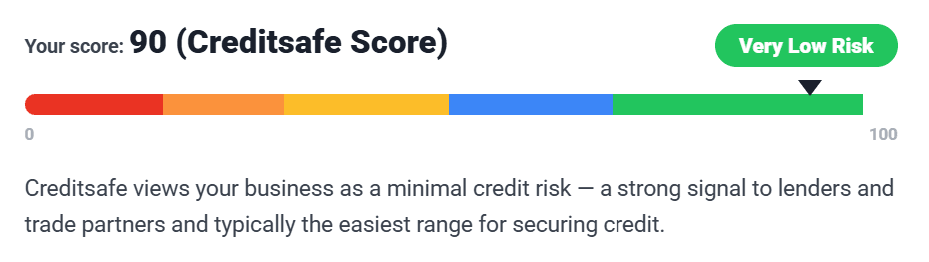
Creditsafe’s Risk Score is another score to use to see how healthy your business is. It shows you what others might see when they’re looking at your financial health and creditworthiness.
Creditsafe’s Risk Score features a score range of 1 to 100. Scores of 71 to 100 are considered very low risk. Scores of 51 to 70 are considered low risk. If they dip lower, these range from moderate risk to very high risk.
Creditsafe also features two other scores that you should pay attention to: the Commercial Delinquency Score and the Business Failure Risk Score.
The Commercial Delinquency Predictor Score features a range of 101 to 600. A higher score indicates that your business is less likely to fall behind on payments.
Meanwhile, the Business Failure Risk Score measures the probability of business failure. This score ranges from 1,001 to 1,650. Higher scores show lenders that your business is healthy and expected to continue operating strongly.
What Is A Good Business Credit Score?
A good business credit score depends entirely on the score in question and your goals.
For example, a good credit score that’s enough to acquire vendor credit may not get you a bank loan.
A good business credit score that will see you seriously considered for funding or credit accounts includes:
| Bureau / Score | Scale | Good Score | Excellent Score |
|---|---|---|---|
| D&B PAYDEX | 1–100 | 75–79 | 80–100 |
| Experian Intelliscore | 1–100 | 76–90 | 91–100 |
| Equifax Business Risk | 101–992 | 788–891 | 892–992 |
| FICO SBSS | 0–300 | 160–199 | 200–300 |
| Creditsafe Risk Score | 1-100 | 51-70 | 71-100 |
A good business credit score can sometimes be sufficient for funding. A strong business credit score will secure:
- Lower interest rate offers
- Higher credit limits
- Net 30/60/90 vendor terms without prepayment
- Lower insurance premiums
- Fewer personal guarantee requirements to get funding
- More loan options so that you can shop around for what works for you
Keep in mind that it takes time to build credit.
You have to start at the bottom with tier 1 vendors. As you move up to tier 2, tier 3, and tier 4 via charge cards, business credit card solutions, and then bank and SBA financing, you’ll unlock the full potential excellent credit has to offer.
It can take anywhere from six to 24 months of active business credit use for new businesses to reach sufficient credit for quality funding. Pay on time or early and leverage credit carefully and strategically. Your efforts will soon show up on credit reports.
What Factors Affect Your Business Credit Score Range?
Understanding what affects your business credit score is integral to improving it. While the impact of factors will vary based on each score, these factors are often most important:
- Payment History: Payment history is the most impactful factor. For scores like the PAYDEX, payment history is the only factor. For Experian, Equifax, and beyond, it has a substantial impact. Even one late payment can set you back.
- Credit Utilization: Credit utilization doesn’t just matter for personal credit. Keeping credit utilization below 30% can bolster your business credit score too. Try to stay well below the full credit limit of each credit card and business line of credit.
- Length of Credit History: You’ll notice that many lenders have a minimum time in business requirement. The longer your business has been around and the more credit history it has, the safer your business appears to lenders.
- Number/Diversity of Trade References: Business tradelines are the foundation of your credit. Having more vendor and supplier accounts reporting to credit bureaus supports you. Having a mix of different account types is important as well.
- Public Records: Public records can shape your business credit. Events like bankruptcy or unresolved tax liens will show up in your business credit report. Look for errors in credit reports and resolve them to protect your business credit.
- Business Demographics: Certain aspects of your business, such as industry and size, can influence scores. This is especially true in regard to the Experian Intelliscore. If you’re in a high-risk industry, you’ll face funding challenges regardless.
How To Check Your Business Credit Score
It’s hard to know where to improve or whether you’re making any progress without a tool that helps you check and track your business credit score.
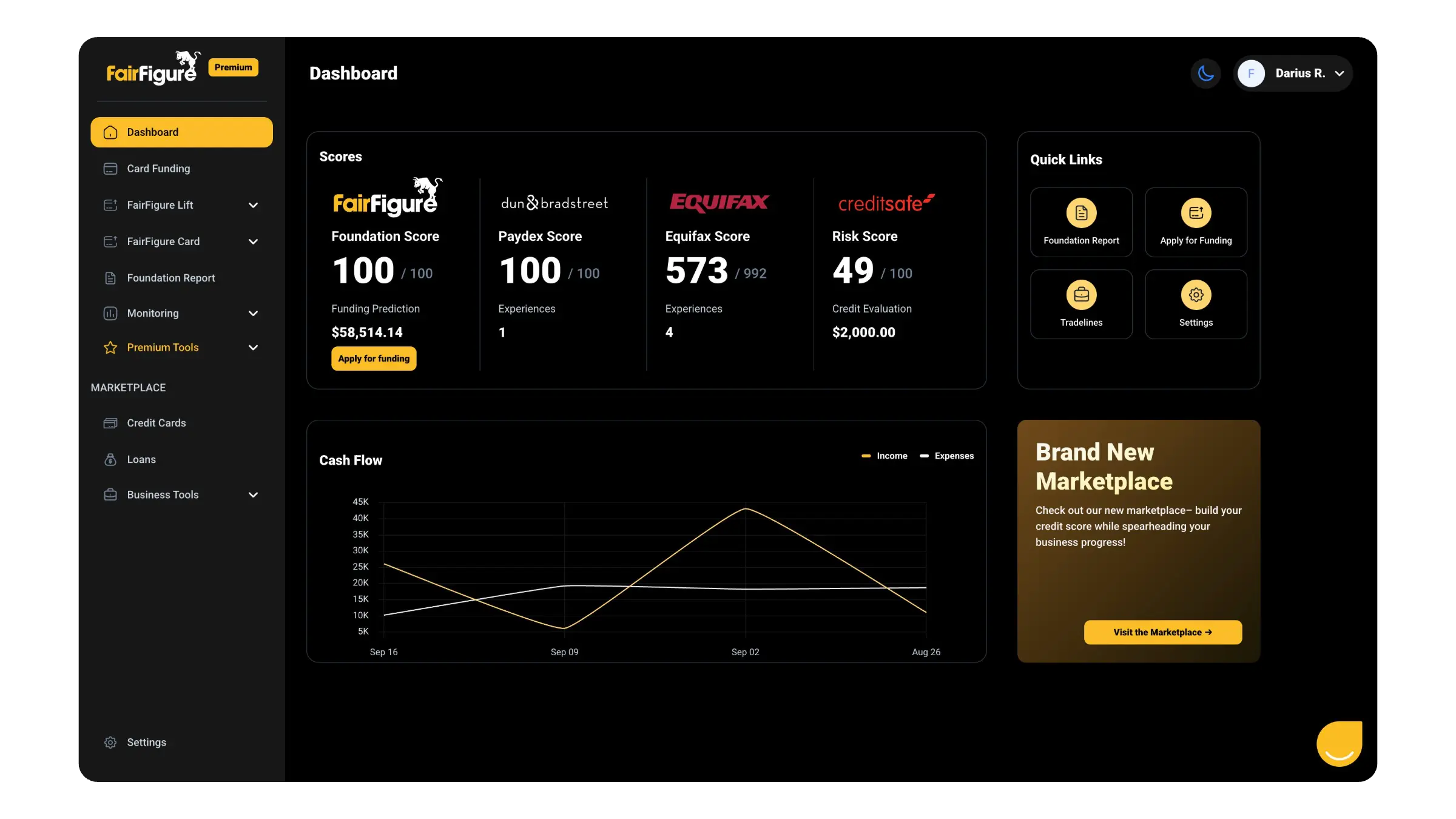
FairFigure offers you the solutions needed to do all of the above. We offer a free business credit check that gives you access to your Creditsafe Risk Score.
With business credit monitoring, you’ll be able to stay on top of your free score moving forward.
If you want access to more scores, you can get FairFigure Premium for $35/month. FairFigure Premium offers:
- Additional scores, such as your Dun & Bradstreet and Equifax Scores.
- Access to additional FairFigure products, including Unify, Pulse, Signal, and Balance.
- A business tradeline.
- Real-time updates for Premium subscribers. (No other business credit tool updates scores and reports the same day.)
- And more.
Sign up now to start monitoring credit reports and improving your business credit.
Business Credit Score Range vs. Personal Credit Score Range
Personal credit score ranges are universal regardless of the credit bureau you’re looking at.
Both FICO and VantageScore have ranges of 300 to 850. Personal credit comes with much stronger protections (via the Fair Credit Reporting Act). You can even access your personal score for free under federal law.
Meanwhile, business credit scores vary greatly. There’s no universal scale used by each credit bureau.
Additionally, there are no laws requiring free access to business credit score checks. Business credit is less regulated overall, and you have to pay to keep an eye on your score.
With that in mind, they’re not entirely separate. As can be seen above, personal credit can influence business credit scores. Some lenders may require a personal credit check when assessing your eligibility for a loan.
It takes time to separate personal credit from business credit. Improving both and focusing on business credit building activity will support you overall.
How To Improve Your Business Credit Score
Whether you don’t have a score or your business credit score is low, you can improve it. Here’s a step-by-step look at how to build business credit as a new business.
- Establish Your Business Entity: Incorporate as an LLC or corporation to separate your personal credit from business credit. Get your EIN from the IRS, a DUNS number, and a dedicated business bank account.
- Open Accounts That Report to Credit Bureaus: Start out with Tier 1 vendor accounts that report to business credit bureaus. Work up strategically. Get more than one business credit card and revolving lines of credit that help you build credit.
- Aim to Make Payments Early: Making early payments will give you a higher PAYDEX score. Always make payments on time or ahead of time. Never make late payments.
- Monitor and Dispute Errors: Business credit report errors are common and can wreak havoc on your score. Diligent monitoring will enable you to catch mistakes and fix them fast. Use FairFigure monitoring and FairFigure's Business Credit Corrector.
- Focus on Low Credit Utilization: Low credit utilization is crucial for credit building. Stay below 30% of your available credit while you’re building your business credit. Work on getting higher limits over time so you don’t hit your max easily.
Business credit scores are much more varied than personal credit. Knowing the different scores across each credit bureau, what they mean, and how they influence lender decisions is a must for small business owners.
FairFigure is here to make your business credit journey easier. With FairFigure Premium, you can monitor your Equifax, Creditsafe, and D&B PAYDEX scores in one place. We also have our FairFigure Foundation report, which gives you insight into your fundability.
Your monthly subscription is reported as a tradeline to Experian Business, Equifax Business, Creditsafe, and the SBFE.
You can also register for the FairFigure Capital Card for an additional tradeline. The FairFigure Capital Card is an EIN-only card that extends funding based on your revenue, not your business or personal credit score.
All you need to qualify is three months in business and $2,500 in recurring monthly revenue.
Understanding business credit is the first step. Taking action to build strong business credit is the next step. Get started with FairFigure today.
More articles
Read More >
October 08, 2026
15 min read
October 08, 2026
12 min read
October 08, 2026
13 min read
Start your credit building journey for your business
Start your credit journey now with FairFigure